Cite BibexPy
Peer-reviewed · SoftwareX 30 (2025)
Kara, B. C., Şahin, A., & Dirsehan, T. (2025). BibexPy: Harmonizing the bibliometric symphony of Scopus and Web of Science. SoftwareX, 30, 102098. https://doi.org/10.1016/j.softx.2025.102098


A self-hosted, reproducible data-preparation platform. Merge, filter, harmonize, enrich and export your records — licensed exports never leave your machine.
$ pip install bibexpy
$ python -m bibexpyPython 3.10+ · Windows / macOS / Linux · No Node.js required · GPL-3.0-or-later
Peer-reviewed · SoftwareX 30 (2025)
Kara, B. C., Şahin, A., & Dirsehan, T. (2025). BibexPy: Harmonizing the bibliometric symphony of Scopus and Web of Science. SoftwareX, 30, 102098. https://doi.org/10.1016/j.softx.2025.102098
New versions and docs — no spam, unsubscribe anytime.
Every step is deterministic by default, fully logged and reversible — built for reproducible bibliometric research.
Multi-stage probabilistic record linkage: exact DOI matching + Jaro–Winkler title similarity, confidence scores and a borderline-review queue.
Author identities resolved with ORCID as deterministic evidence; constrained field-similarity fallback only when coverage is incomplete.
Organization roll-up to a canonical parent institution plus country standardization — cleaner collaboration networks.
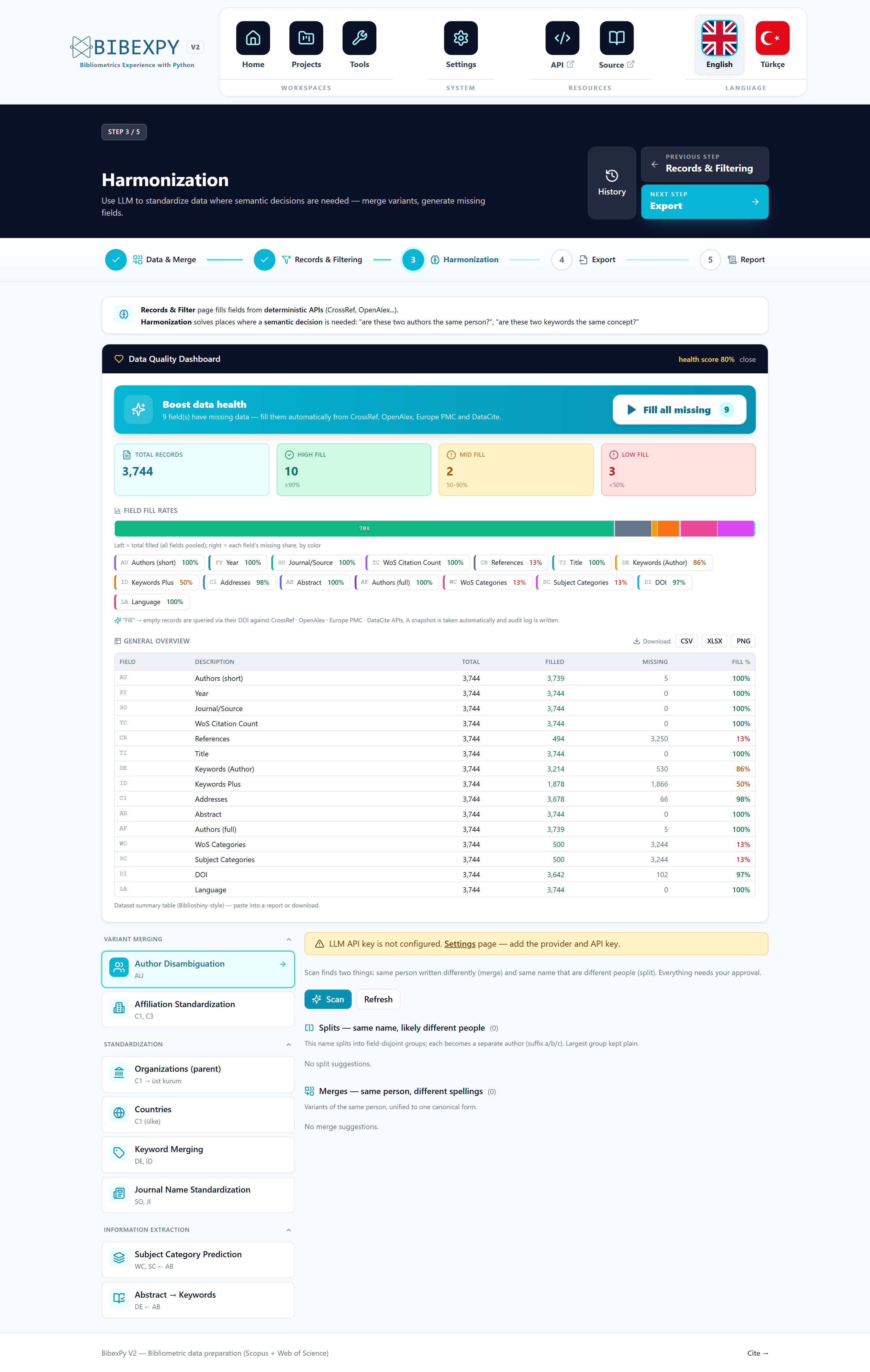
Fetch-once-fill-all across CrossRef, OpenAlex, Scopus, DataCite, Unpaywall, Europe PMC and Semantic Scholar. Verifiable values only.
Multi-facet inclusion/exclusion criteria with a live match count, saved as reusable presets — your corpus is reconstructable.
A health score that weighs the fields your analysis depends on — abstract, keywords, DOI, affiliations and cited references — not raw completeness.
Append-only audit log, pre-operation snapshots, isolated analyses and an auto-generated methodology narrative.
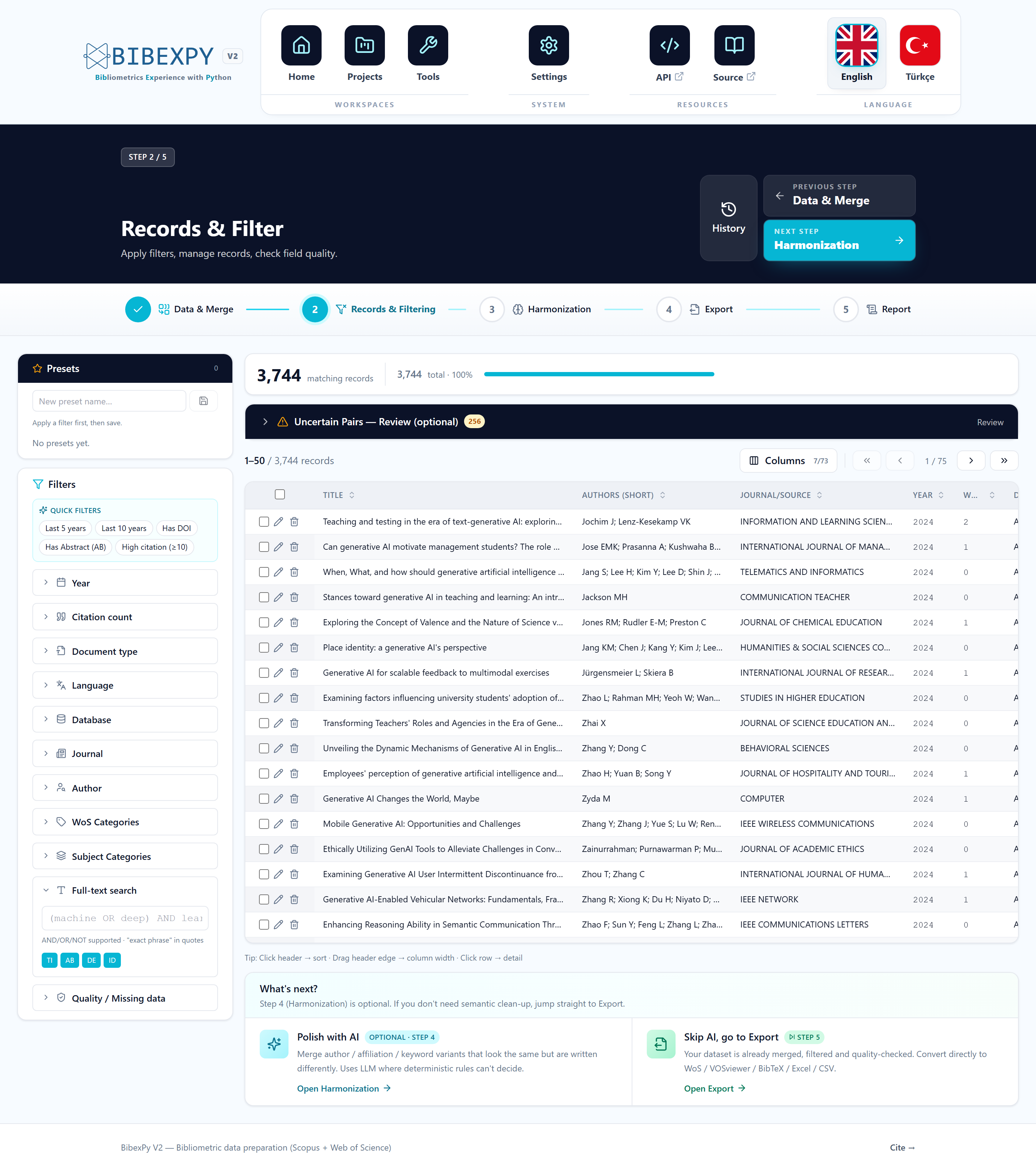
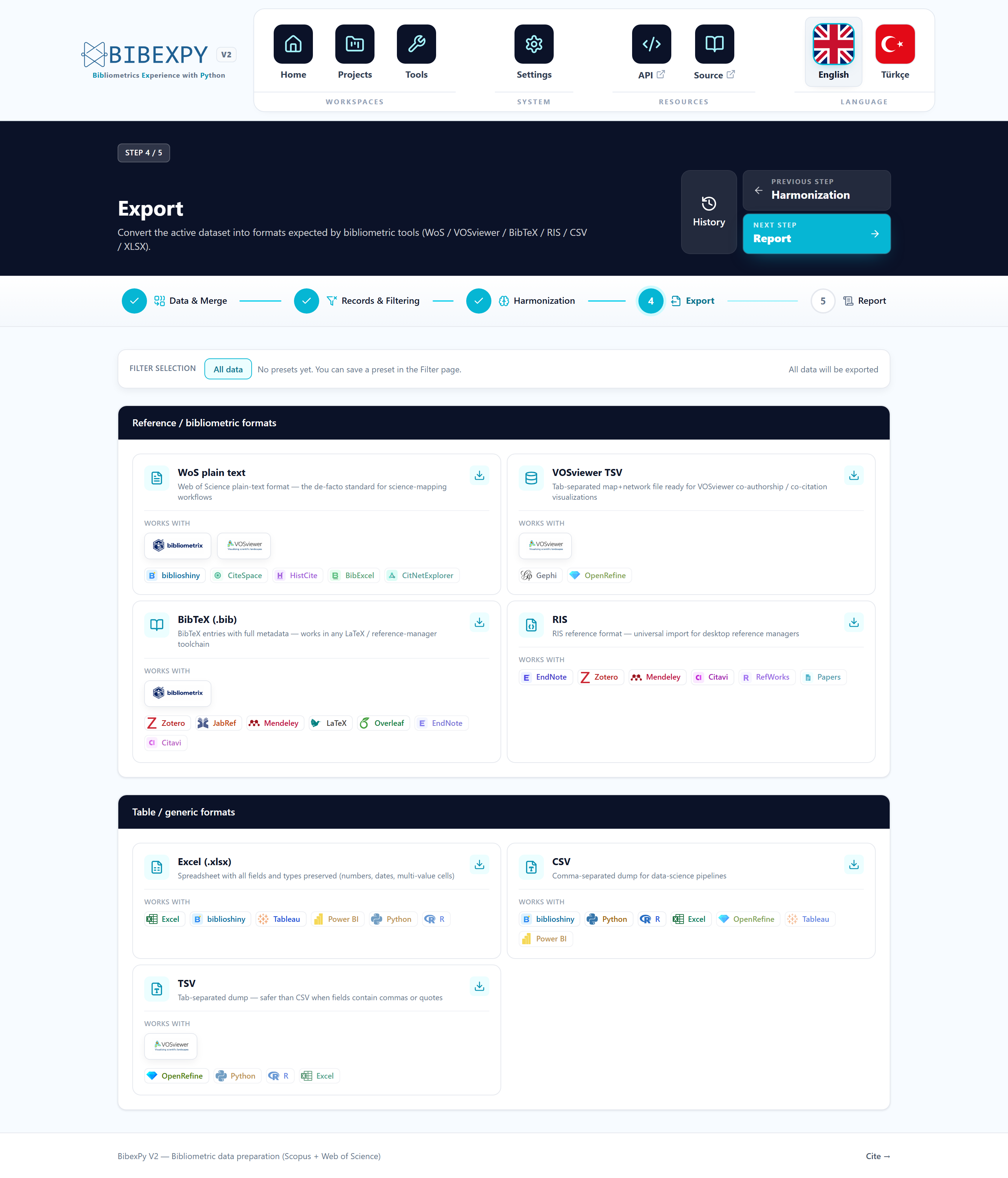
WoS plain text, VOSviewer TSV, BibTeX, RIS, CSV, TSV, XLSX — interoperable with VOSviewer, Biblioshiny, CiteSpace and more.
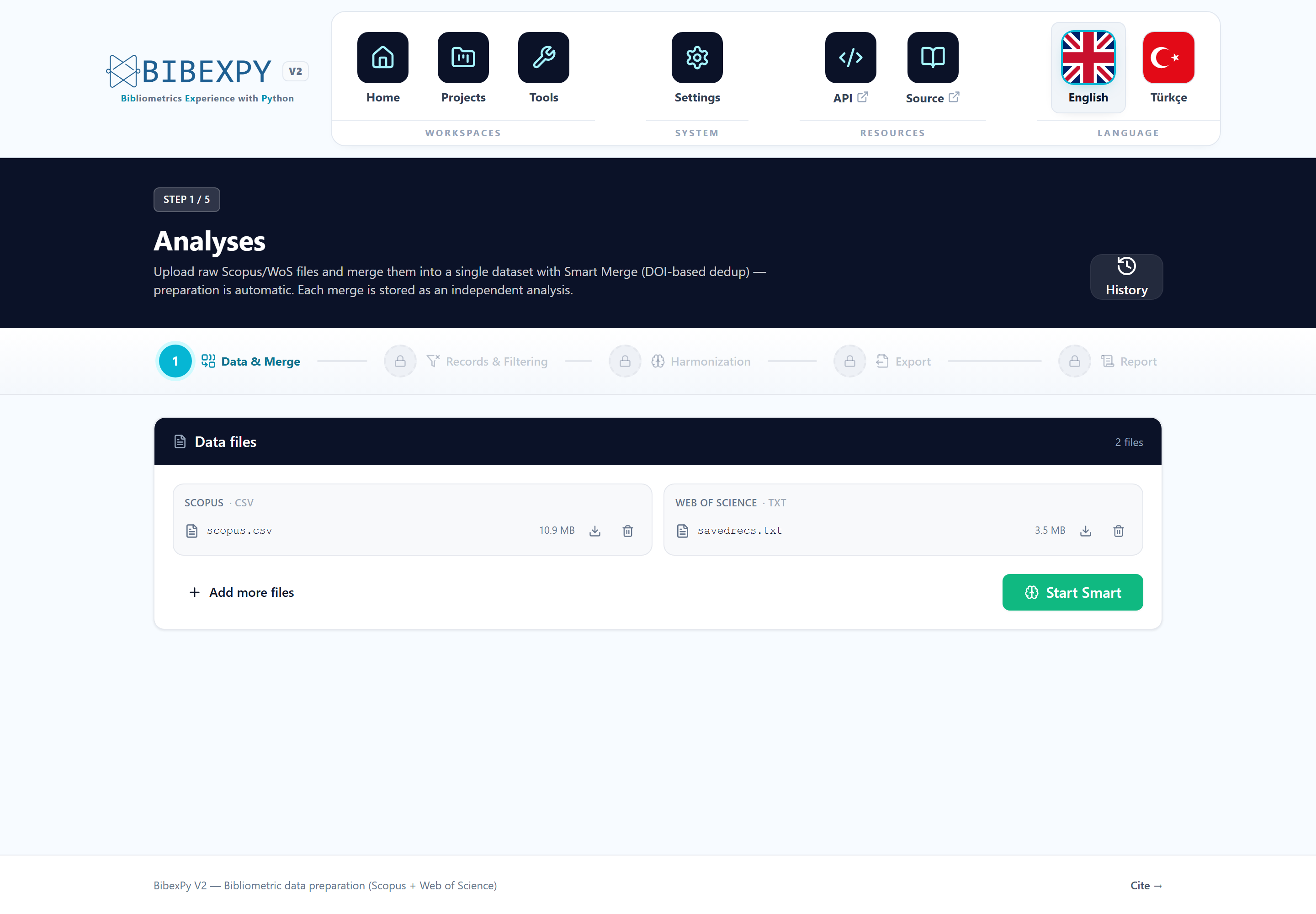
Data & Merge → Records & Filtering → Harmonization → Export → Report. Each step is gated until the previous one is complete.
Swipe left or right to explore the steps
BibexPy ships as a single pure-Python wheel with the web interface precompiled inside. Python 3.10+ is the only requirement — it runs the same on Windows, macOS and Linux.
pip install bibexpy
python -m bibexpy
If bibexpy isn't recognized, that's a PATH issue — on first launch the app offers to add itself to PATH (answer Y), or see Troubleshooting.
A lightweight companion that runs the same Smart Merge (Web of Science + Scopus deduplication) in Google Colab or a terminal — no installation.
The first launch creates a ready-to-explore Simple Project with real Web of Science + Scopus sample exports — run the whole pipeline end-to-end.
Release notes straight from GitHub — BibexPy is actively maintained, and every version is documented.
Real feedback from teams using BibexPy to prepare reproducible bibliometric datasets.
Built and maintained by three researchers — peer-reviewed and published in SoftwareX.

Department of Construction, Merzifon Vocational School, Amasya University
ORCID 0000-0002-6933-0759
Electronic Commerce and Management Department, Istanbul Esenyurt University
ORCID 0000-0001-9563-6543
Department of Business Administration, Marmara University
ORCID 0000-0002-3599-0951Published in SoftwareX 30 (2025), 102098 — citation formats (APA · BibTeX · RIS) are one click away at the top of this page.